2. Installation
2.1 Servomotor
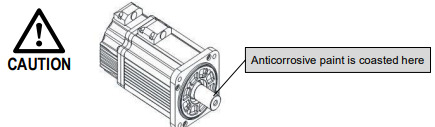
Anticorrosive paint is coated on the edge of the motor shaft to prevent it from rusting during storage. Clean off the anticorrosive paint thoroughly using a cloth moistened with thinner before installing the motor.
2.1.1 Conditions
Storge
When the Servomotor is to be stored with the power cable disconnected, store it in the following temperature range: Between -20 and 60℃.
Installation Sites
The servomotor is designed for indoor use. Install the servomotor in an environment which meets the following conditions:
Free from corrosive and explosive gases.
Well-ventilated and free from dust and moisture.
Ambient temperature of 0 to 40℃.
Relative humidity of 26% to 80% (non-condensing).
Inspection and cleaning can be performed easily.
Installation Orientation
You can install the Servomotor either horizontally or vertically.
However, you shall install the Servomotor according to the actual use of the machine, which makes the motor work best with the machine for ensuring the service life of the Servomotor or avoiding accidents.
Using Servomotors with Holding Brakes
This section gives precautions for using Servomotors with Holding Brakes.
The holding brakes have a limited service life. Although the quality and reliability of a holding brake has been sufficiently confirmed, stress factors, such as emergency braking, can results in problems in the holding operation. In applications in which safety is a concern, such as for a load falling on a vertical axis, determine if safety measures are required on the machine, such as adding a redundant fall-prevention mechanism.
For a Servomotor with a Holding Brake, there is a small amount of rotational play in the motor shaft (1.5° max. initially) because of the backlash in the holding brake, even when the brake power is OFF
For a Servomotor with a Holding Brake, the brake’s rotating disc may sometimes generate murmur from friction during acceleration, stopping, and low-speed operation.
Using Servomotors with Oil Seals
This section gives the operating conditions for using Servomotors with Oil Seals.
Keep the oil surface below the oil seal lip.
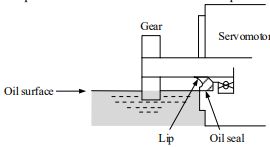
Use the oil seal in favorably lubricated condition with only splashing of oil.
Never let the oil collect in the oil seal lip.
Never use the Servomotor where the oil seal would be below the oil surface. If you do, oil will enter the Servomotor, which may damage the Servomotor.
2.1.2 Coupling to the Machine
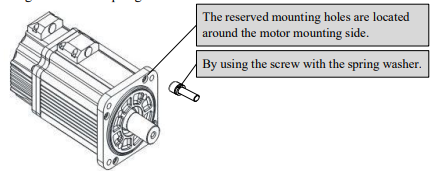
For instlling the motor to the client, connect the motor with the load via the reserved mounting hole by using screws with spring washers.
Using a Coupling

1. Wipe off all of the anticorrosive coating from the motor shaft.
2. If you are using a Servomotor with a Key, attach the key enclosed with the Servomotor or the specified size of key to the shaft.
3. Confirm that the centering accuracy is within the specified range using a dial gauge or other means. If a dial gauge is not available, slide the coupling along both shafts and make adjustments so that it does not catch.
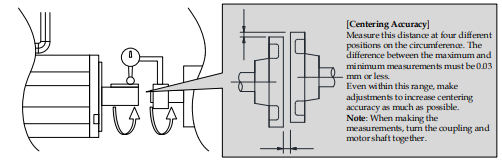
4. Align the shaft of the Servomotor with the shaft of the machine, and then connect the shafts with the coupling.
When you couple the shafts, make sure that the required centering accuracy is achieved. Vibration will damage the bearings and encoders if the shafts are not properly centered.
When you attach the coupling, do not subject the shaft to direct shock. Also, do not subject the area around the encoder to shock. Shock may damage the encoder.
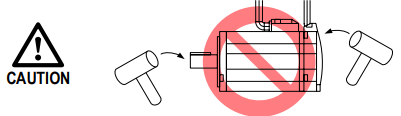
If the coupling makes any abnormal noise, center the shafts again until the noise is eliminated.
Make sure that the thrust load and radial load are within specifications. Refer to the specifications for each type of Servomotor for the thrust load and radial load.
Using a Belt

1. Wipe off all of the anticorrosive coating from the motor shaft.
2. If you are using a Servomotor with a Key, attach the key enclosed with the Servomotor or the specified size of key to the shaft.
3. If you need to attach a pulley to the Servomotor with a Key, use a screwdriver to tighten the screw in the end of the motor shaft to press in and attach the pulley.
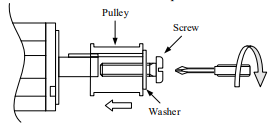
4. Couple the Servomotor to the machine with a belt.
When you attach the belt, adjust the belt tension so that the allowable radial load given in the Servomotor specifications is not exceeded. For details, refer to the catalog of the belt manufacturer.
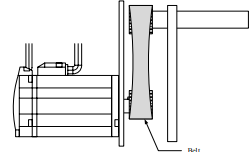
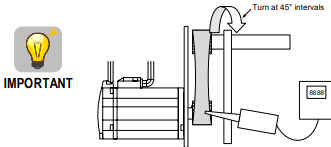
Adjust the belt tension to adjust the radial load. Measure the belt tension at 45° intervals of the machine shaft. Turn the shaft and take measurements with a belt tension meter at each point.
2.2 Servodrive
Storge
When the Servomotor is to be stored with the power cable disconnected, store it in the following temperature range: Between -20 and 85℃.
Environmental Conditions
Ambient temperature is from 0℃ to 55℃.
Ambient humidity is low than 90%RH, and free from condensation.
Vibration is low than 4.9m/s2.
It is recommended the ambient temperature shall be below 45℃ to ensure the stable operation.
Installation Sites
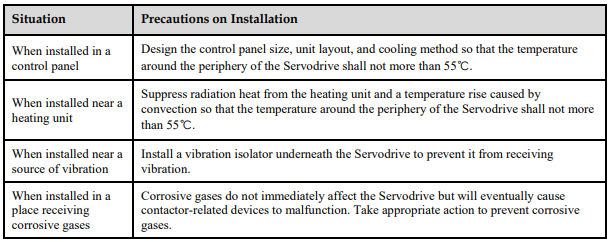
The following table lists some precautions on installation sites.

Mouting Orientation
As is shown in the following figure, the Servodrive is installed perpendicular to the base.
Prepare two mounting holes for the Servodrive and mount it securely in the mounting holes. In addition, let the front panel of the Serovdrive is facing toward the operator.
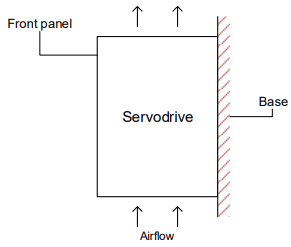
A fan can be added to force cooling the Servodrive if necessary
Mounting Interval
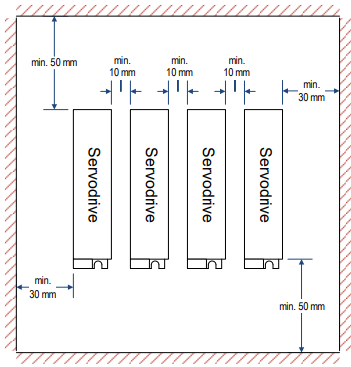
When you install one Servodrive in the control panel, provide the following spaces around the Servodrive
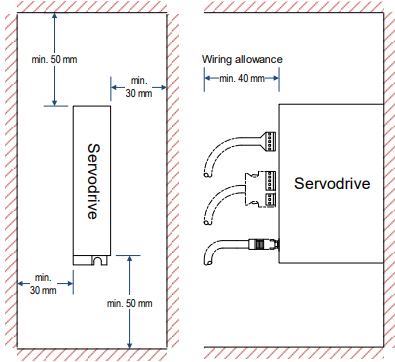
When you install more than one Servodrive in the control panel, provide the following intervals between the Servodrives and spaces around the Servodrives. Install cooling fans above the Servodrives so that hot spots do not occur around the Servodrives. Provide sufficient intervals and spaces as shown in the following figure to enable cooling by the fans and natural convection.