1. Brief introduction of EtherCAT
1.1 What is EtherCAT
EtherCAT is an open network based on Ethernet to achieve real time control. It could support high speed and synchronized control. By using efficient network topology, the network structure with too many concentrator and complicated connections are avoided. It is very suitable to use this protocol in motion control and other factory automation applications. EtherCAT is registered trademark and patented technology, licensed by Beckhoff Automation GmbH, Germany.
1.2 EtherCAT general introduction
EtherCAT technology breaks the limits of normal internet solution. Through this technology, we don’t need to receive Ethernet data, decode the data, and then copy the process data to different devices. EtherCAT slave device could read the data marked with this device’s address information when the frame passes this device. As the same, some data will be written into the frame when it passes the device. In this way, data reading and data writing could be done within several nanoseconds. EtherCAT uses standard Ethernet technology and support almost kinds of topologies, including the line type, tree type, star type and so on. Its physical layer could be 100 BASE-TXI twisted-pair wire, 100BASE-FX fiber or LVDS (low voltage differential signaling). It could also be done through switch or media converters or in order to achieve the combination of different Ethernet structure. Relying on the ASICs for EtherCAT in the slave and DMA technology that reads network interface data, the processing of the protocol is done in the hardware. EtherCAT system could update the information for 1000 I/O within 30µs. It could exchange a frame as big as 1486 bytes within 300µs. This is almost like 12000 digital output or input. Controlling one servo with 100 8-byte I/O data only takes 100µs. Within this period, the system could update the actual positions and status presented by command value and control data. Distributed clock technology could make the cyclic synchronous error lower than 1µs.
1.3 Product introduction
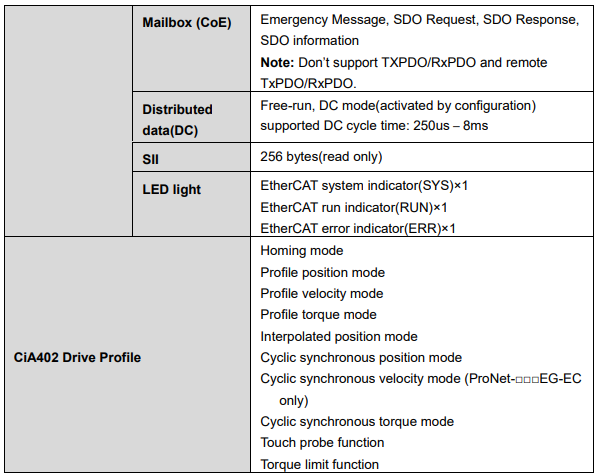
ProNet servo drive achieves EtherCAT communication through EC100 network module. It is a real time Ethernet communication and the application layer applies CANopen Drive Profile (CiA 402). Besides supporting the PV, PP, IP, HM, PT and other control mode defined in CANopen DS402, this module also supports CSP, CSV (ProNet-□□□EG-EC only)Touch Probe Function and Torque limit Function. Clients could switch the control mode by changing correspondent parameters. It is available from simple velocity control to high speed high precision position control.
1.4 CoE terms
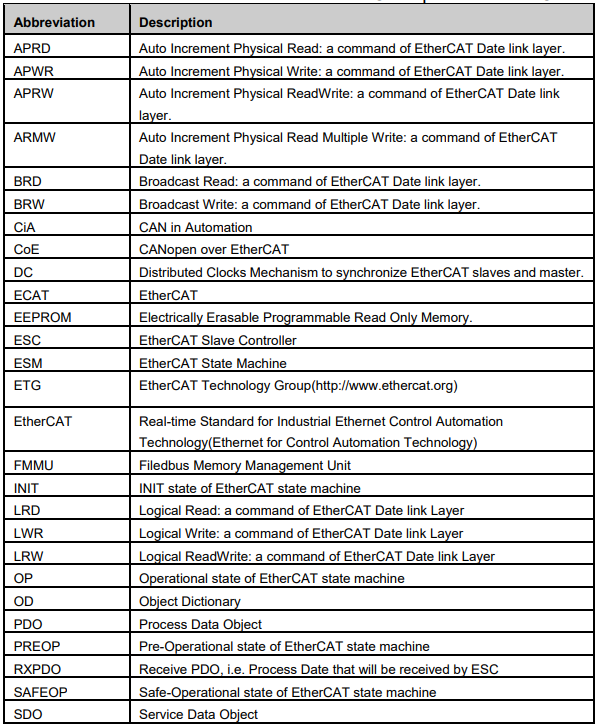
The tables below lists the terms used in CANopen and EtherCAT.

1.5 Data type
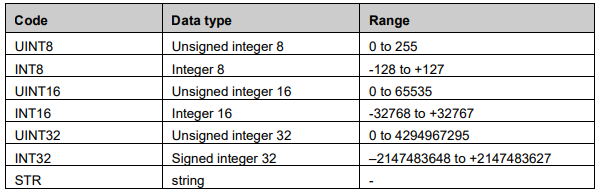
The table below lists all the data types and their range that will be used in this manual.
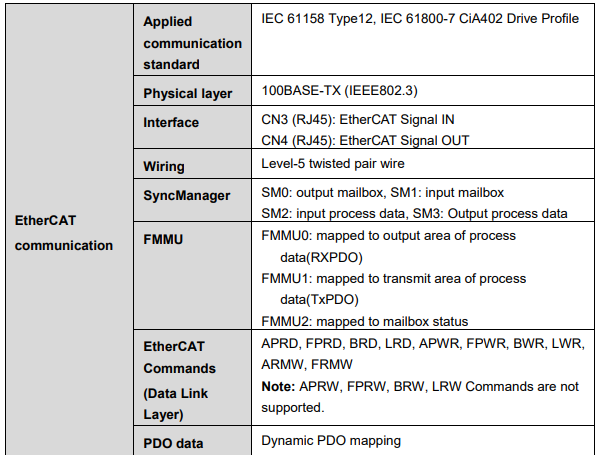
1.6 Communication specifications
1.7 LED indicators
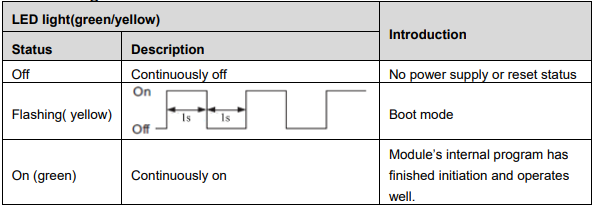
SYS
SYS light is used to show the software status in the module.
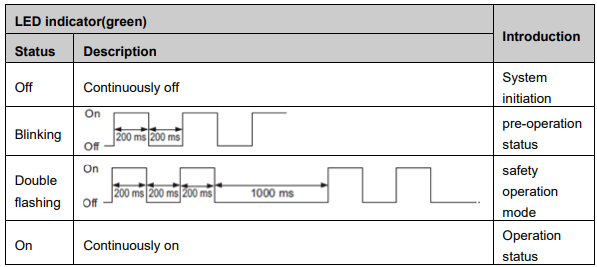
RUN
RUN light is used to indicate the communication status of EtherCAT
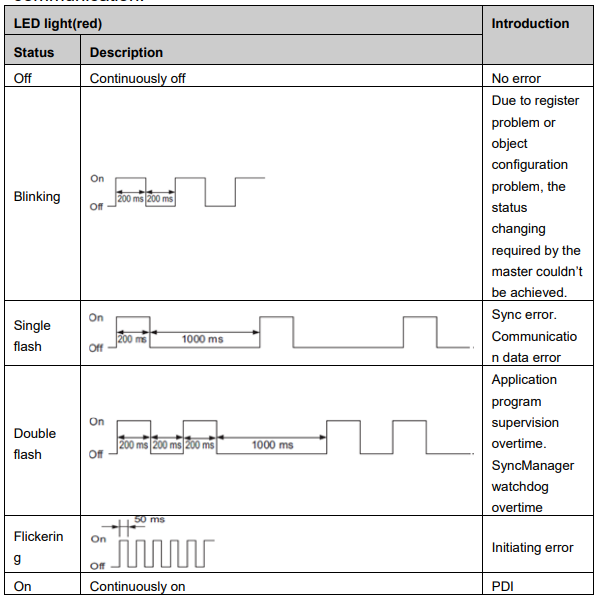
ERR
ERR light is used to indicate the error in EtherCAT communication.

LINK/ACT (green light on RJ45 COM1/COM2)
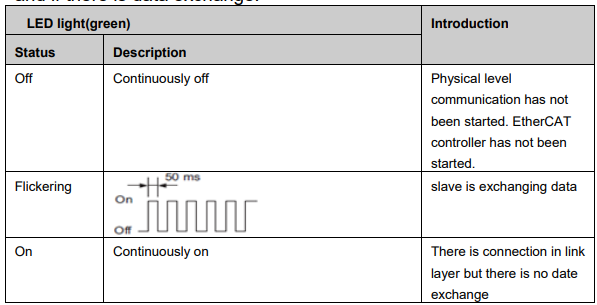
LINK/ACT light is used to indicate the physical communication and if there is data exchange.