
2. Safety
2.1 Introduction
This chapter describes the safety principles and procedures that need to be noted when using the robot. The contents related to the design and installation of the external safety protection devices of the robot are not covered in this chapter. You can contact your system integrator to obtain such information.
2.2 Safety responsibilities
ROKAE is dedicated to but not liable for providing reliable safety information. Even if all operations are carried out according to the safe operation instructions, we can not guarantee that our industrial robots will not cause personal and property losses.
2.3 Safety symbols
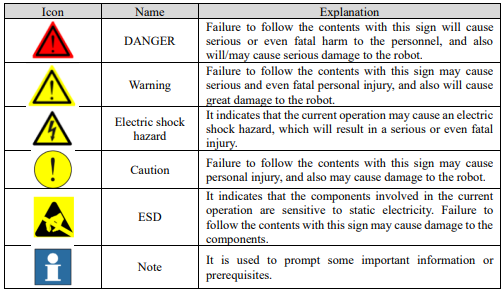
There may be different degrees of danger when operating the robot in accordance with the Manual, so there will be a special safety symbol in the vicinity of dangerous operation instructions to remind the user to be careful. The contents include:
An icon that indicates safety level and the corresponding name, such as warning, danger, note, etc.;
A brief description given to illustrate the possible consequences if the operator fails to eliminate the danger;
The operating instructions on how to eliminate dangers.
2.3.1 Safety leveL
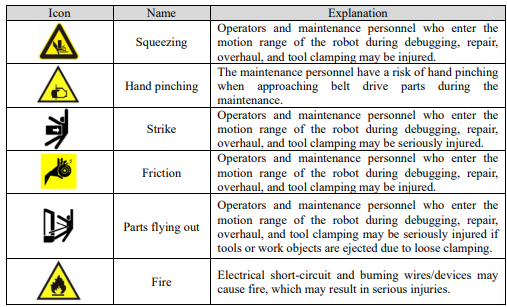

2.3.2 Hazard description
2.4 Safe stop
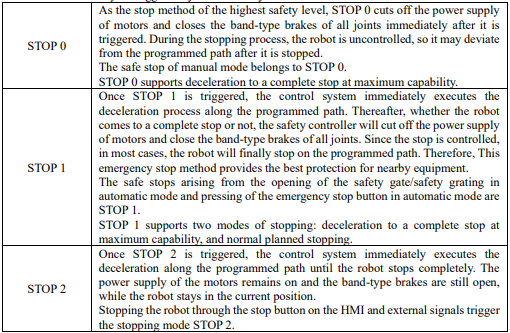
There are three ways to stop the robot: STOP 0, STOP 1, and STOP 2. Safe stop refers to a stop triggered by the safety controller, which only supports STOP 0 and STOP 1, while STOP 2 can only be triggered by the control system.

2.5 Safety devices
2.5.1 Emergency stop (E-stop)
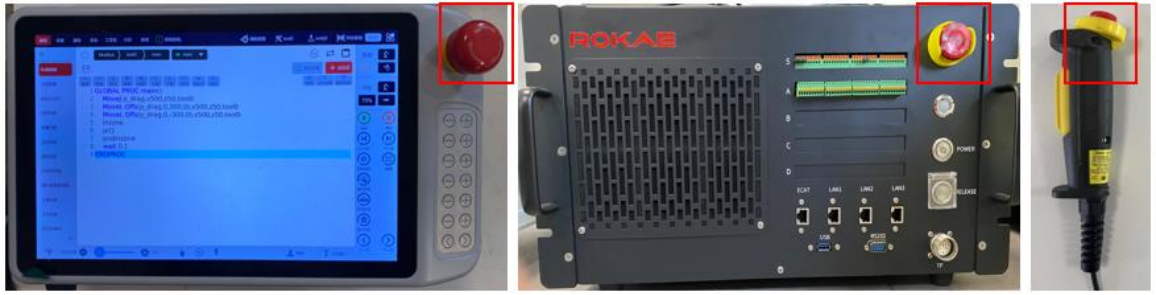
Emergency stop buttons are for manually triggering an emergency stop, and most of them are red in the shape of a mushroom head. In general, a yellow substrate, protective casing, or warning sign is also attached to the emergency stop button.
The emergency stop button is mechanically locked through the safety lock mechanism when it is pressed and must be reset through manual release. Most emergency stop buttons are released by rotation along the rotation direction indicated on the button surface. Additionally, some buttons also support releasing by upward pulling.
2.5.2 Enabling device
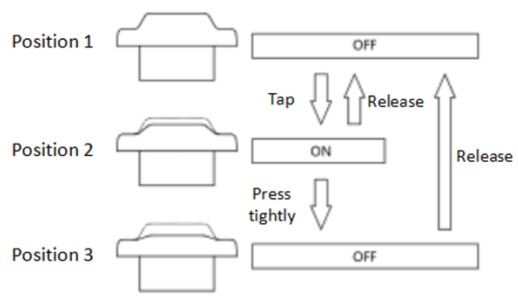
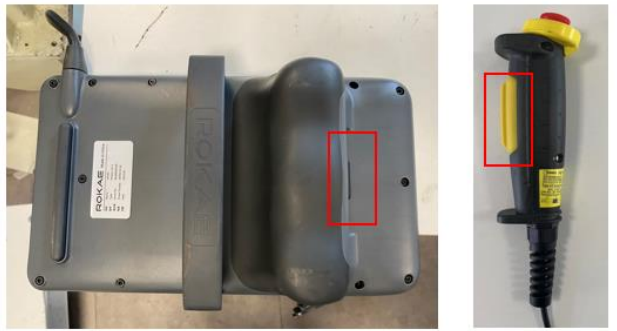
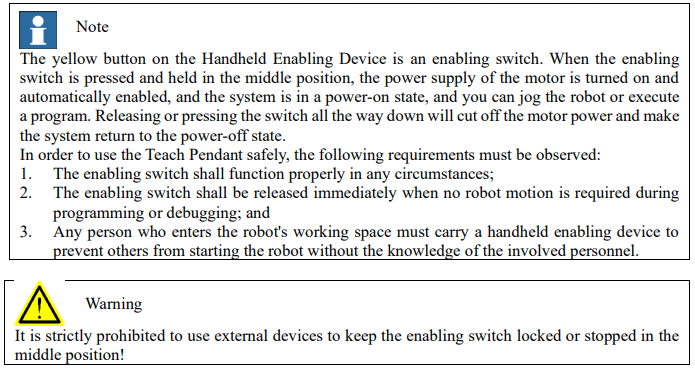
The enabling device is a special switch with 2 segments of pressing and 3 positions, which is also called three-position enabling switch (hereinafter referred to as “enabling switch”), and is used to control the on and off of the power supply of the robot in the manual mode, thus realizing the motion enabling of the robot. The motor power is powered on only when the enabling switch is pressed and kept in the middle so that the robot is in a state ready for motion. Releasing or pressing the switch all the way down will cut off the motor power
2.6 Safety precautions in various situations
2.6.1 Safety precautions in manual mode
In manual mode, the motion of the robot is under manual control. You can only Jog the robot or execute a program when the enabling switch is held in the middle position. The manual mode is used during the programming and debugging of the robot, as well as the commissioning of the workstation.
2.6.1.1 Speed limit in manual mode
The motion velocity of the robot end-effector is limited to less than 250 mm/s in manual mode, that is, no matter when you Jog the robot or execute a program, regardless of the set velocity in the program, the maximum motion velocity of the robot end-effector will not exceed 250 mm/s.
2.6.1.2 Bypassing external safety signals
In manual mode, signals of external safety devices such as the safety door and safety grating will be bypassed, i.e. in manual mode, the system can still perform motor-enabling operations even if the safety door is opened, and the system will not prompt the safety door opening information for the convenience of debugging.
2.6.2 Safety precautions in auto mode
The auto mode is used for robot program running during the formal production process. In auto mode, the enabling switch will be bypassed so that the robot can run automatically without manual
intervention.
2.6.2.1 Activating external safety signals
In auto mode, external safety devices such as the safety door and safety grating will be activated. When the safety door is opened, the motor power supply will be cut off and the band-type brake will be closed.
2.6.3 Safety requirements for installation and operation
⚫ Handling and installation of the robot equipment must be carried out according to the methods described in the Manual. Otherwise, the robot may fall due to misoperation, thus leading to personal injury and death or equipment damage.
⚫ When the robot equipment is put into use for the first time after installation, it is necessary to run it at low velocity first and then gradually increase the velocity rather than running it at high velocity from the start.
⚫ By default, program and system variable information is stored in the controller storage device. In order to prevent data loss caused by accidents, it is recommended that the user makes data backups regularly.
2.6.4 Safety requirements for debugging
Debugging shall be carried out outside the safeguarded space as much as possible. When debugging must be carried out inside the safeguarded space, special attention shall be paid to the following matters:
⚫ Carefully check the situation inside the safeguarded space and enter into it only after confirming there is no danger.
⚫ Confirm the positions of all debugging personnel inside the safeguarded space.
⚫ Confirm the status of the entire system before proceeding with the work.
⚫ Make sure that the emergency stop button can be pressed whenever necessary.
⚫ Run the robot at low velocity.
⚫ When the above debugging is finished, the debugging personnel must stay outside the safeguarded space.
2.6.5 Safety requirements for maintenance
⚫ It is necessary to carefully check the situation in the safeguarded space and confirm that there is no danger before entering the safeguarded space. The positions of all maintenance personnel in the safeguarded space shall be confirmed.
⚫ When the power supply is switched on, some maintenance operations may pose a risk of electric shock. Therefore, the power supply of the robot equipment and system needs to be cut off before the maintenance is carried out.
⚫ During the maintenance, other personnel shall be prevented from switching on the power supply accidentally.
⚫ To avoid unnecessary personal injury or adverse impact on the equipment, you shall not place any part of your body on any part of the robot equipment during the operation.
⚫ Appropriate lighting shall be provided during the maintenance.
⚫ In case of part replacement, make sure to use parts specified by ROKAE. Otherwise, the robot equipment may be damaged.
⚫ Parts removed during the replacement (such as screws) shall be correctly installed back to their original positions. If you find the parts not enough or redundant, you need to confirm again and make sure to install them correctly.
2.6.6 Safe handling on the production line
In most cases, the robot is just a part of the production line. Therefore, robot faults will not only affect the robot itself, but may also affect the entire production line. Likewise, problems with other parts of the production line may also affect the robot. For this reason, a fault remedial plan shall be designed by personnel who are very familiar with the entire production line to improve the safety of the whole system.
⚫ Pay attention to other devices that interact with the robot
For example, when a robot needs maintenance, you must first remove it from the production line, as well as remove other devices interacting with the robot, such as the robot responsible for feeding materials to the above robot.
⚫ Pay attention to other running devices around the robot
For example, robots on the production line need to grab work objects from the conveyor belt. Therefore, when a robot fails, in order to guarantee uninterrupted production, the conveyor belt may keep running while the robot is being repaired. The robot maintenance personnel must pay extra attention to safety, give advance consideration to the risks that might arise from the running conveyor belt, and develop detailed safety measures for working in such an environment.
2.6.7 Safe handling of fire
It is required to keep calm when a fire hazard is imminent or has not yet begun to spread. You can use on-site fire-extinguishing devices to put out the flame. It is strictly prohibited to use water to put out a fire caused by a short-circuit fault.

If the fire has spread and is beyond control, the workers on the site shall notify other workers immediately to give up their personal belongings and evacuate immediately through emergency exits rather than try to put out the fire. DO NOT use the elevators, and be sure to inform the fire brigade during evacuation. If one person's clothing catches fire, ask him/her not to run but to lie flat on the ground immediately, and put out the fire using clothes or other suitable items and methods.
2.6.8 Safe handling of electric shock
When someone gets an electric shock, do not panic and cut off the power supply immediately. Appropriate methods and measures shall be adopted without hesitation according to specific site conditions. Generally, there are several methods and measures as follows:
1. If the power switch or button is very near to the point of the electric shock, it shall be switched off at once to cut off the power supply.
2. If the power switch or button is far away from the point of the electric shock, it is recommended to use insulated pliers or an axe, knife, and shovel with a dry wooden handle to cut off the live wire on the mains side (power supply side), and the cut wire must not contact with the human body.
3. If the wire is over or under the body of the victim, it is suggested to use a dry stick, board, bamboo pole, or other tools with an insulated handle (by gripping the insulated handle) to remove the wire. No metal bar or wet object shall be used to prevent the rescuer from also getting an electric shock.
Handling of the victim after separation from the power source
1. If the victim is conscious, make him/her lie on the back, keep a close watch over him/her, and let him/her not stand or walk for the time being.
2. If the victim is confused, make him/her lie on the back to keep the airways open, and call the victim or pat him/her on the shoulder at an interval of 5 seconds to judge if he/she loses consciousness completely. Do not call the victim by shaking his/her head. Meanwhile, contact the hospital as soon as possible.
3. If the victim loses consciousness, confirm his/her respiratory conditions and heartbeat within 10 seconds. If neither breath nor arterial pulse is sensed, the victim may have a cardiac arrest and shall be given immediate first aid treatment by cardiopulmonary resuscitation.