
Instructions for Safe Use
This Chapter describes the content to be observed for the safe use of the robot. Before using, be sure to read and understand the content in this Chapter.
Companies and individuals using ESTUN Robotics should be familiar with the local and national standards and laws. Appropriate safety facilities shall be provided to protect users. Before use (installation, operation, maintenance and repair), please be sure to read and understand this Manual as well as other ancillary materials thoroughly, and use it after being familiar with all knowledge on equipment, safety and precautions. However, ESTUN would not guarantee that the user will absolutely not be injured even if he follows completely all the safety information given in the Manual.
DEFINITION OF USER
The personnel can be defined as follows.
Operator
To turn the robot power ON/OFF.
To start the robot program from the panel.
Programmer
To operate the robot.
To teach the robot in a safe area.
Maintenance engineer
To operate the robot.
To teach the robot in a safe area.
To carry out the robot maintenance (repair, adjustment, replacement).
Operator must not work in a safe area.
Programmer and maintenance engineer can work in a safe area.
During operation, programming, and maintenance of the robot, the operator, programmer, and maintenance engineer should take precautions to ensure the safety by wearing the following safety items.
Clothes for operation
Safety shoes
A helmet
SPECIAL TRAINING
Tasks in the safe area including transportation, setting, teaching, adjustment, maintenance, etc.
Training course must be performed before operating the robot.
For more information about training course, contact ESTUN.
Safety Symbols
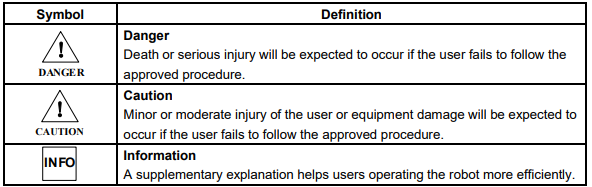
If the manual contains instructions marked as follows, users must read them carefully and follow strictly
Safety precautions for users
(1) The robot should be transported and installed as procedures recommended by ESTUN. Wrong procedures may cause severe injuries or damage due to the robot fall.
(2) Draw an area clearly indicates the safety area. Install a fence or hang a warning board to ensure the safety operation of the robot, and keep unauthorized personnel outside the safety area.
(3) Never hang any tools above the robot. Falling of these tools may cause damage to equipment.
(4) Never lean on the cabinet. Never touch any buttons without permission. Unexpected movement of the robot may cause personnel injuries and equipment damage.
(5) Take precautions for falling parts to avoid injuries when disassemble the robot.
(6) Turn off the power when adjusting peripheral equipment.
(7) Peripheral equipment must be grounded.
(8) The robot should be operated in a low speed in the first operation. The speed should be added gradually to check if there is any abnormal situation.
(9) Do not wear gloves when using the teach pendant. Operate with gloves may cause an operation error.
(10) Programs, system variables, and other information can be saved on the memory card or USB memories. Be sure to save the data periodically in case that the data is lost.
(11) Never forcibly move any axis of the robot. Move the axes forcibly may cause injuries or damage.
(12) Take precautions when wiring and piping between the robot, the cabinet, and peripheral equipment.
Put the pipes, wires or cables through a pit or covered with a protective lid, to avoid stepped by personnel or run over by a forklift.
(13) Unexpected movement may occur on any operating robot, which will cause severe injuries or damages in the working area. Test (safe door, brake, safe indicators, etc.) must be performed on each safety measures before using the robot. Before turn on the system, make sure that no one is in the working space.
(14) Never set motion range or load condition exceeds the rated range. Incorrect setting may cause personnel injury and equipment damage.
(15) Observe the following precautions when teaching inside the working space of the robot
Do not enable the system unless the mode is switched to manual, and make sure that all autocontrol is cut off.
Speed must be limited under 250mm/s at manual mode. Only authorized person with fully understand of the risks can adjust the robot to rated speed manually.
Be careful about rotating joints to prevent hair and clothes involved. Take precautions of injury or damage caused by the manipulator or other auxiliary devices.
Check the motor brake to avoid personnel injuries caused by unexpected situation.
Always have an escape plan in mind in case the robot comes towards you unexpectedly.
Ensure that there is a place to retreat to in case of emergency.
Operators:
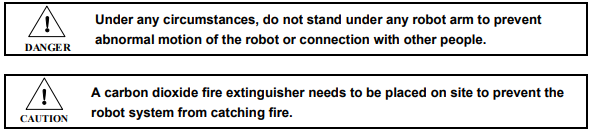
(1) Before operate the robot, you should press E-stop button, which is on the teach pendant or the upper right of electric cabinet, in order to check whether the indicator of Servo Ready is not light, and make sure the power of the indicator is turnoff.
(2) In course of operation, never allow the non-work personnel to touch the control cabinet. Otherwise, the robot might bring some unexpected movements, which can cause personal injury or equipment damage.
(3) When you install a device on the robot, the power supplies of the control cabinet and the device must be cut off (OFF), and then hang a caution sign. If you power on in your installation, it might cause the danger of electric shock, or the robot might bring some unexpected movements, which can cause personal injury.
(4) E-stop
The E-stop is independent of the electrical control of all robots, and it can stop all robot motions.
E-stop means that all power supplies to the robot are disconnected, but the power to the brake on the servomotor is not disconnected. The robot can work again after releasing E-stop button and restarting the robot.
Programmers:
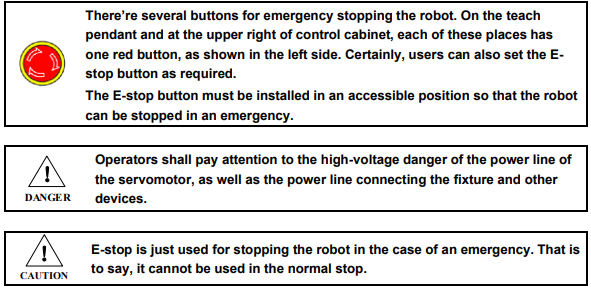
While teaching the robot, and in some cases, the programmer needs to enter the range of the
robot's movement, so be sure to keep himself safe.

To ensure the safe use of the teach pendant, the following rules must be observed:
Ensure that the enable button works at all times.
Disconnect the enabling timely when temporarily stopping the robot, programming or testing.
When entering the robot working space, the demonstrator shall bring the teach pendant to avoid other people operating the robot without the programmer is informed.
The teach pendant must not be placed within the working space of the robot to prevent abnormal actions in case of collision between the robot and the teach pendant.
Maintenance personnel:
(1) Pay attention to the parts in the robot that are prone to become hot
Some parts of the robot in normal operation will become hot, especially the servomotor and reducer, which may cause burns when being approached or touched. When it is inevitable, protective equipment such as heat-resistant gloves should be worn.

(2) Safety precautions on removing parts
Ensure that the internal parts such as the gears are no longer rotating, and then you can open the lid or the protection device. You shall not open the protection device when the gears and bearings are rotating. If necessary, use the auxiliary device to make the internal unfixed parts remains its original position.
The initial test upon repair, installation and maintenance shall be carried out by following the steps below:
a) Clean up the robot and all maintenance and installation tools in the working space of the robot.
b) Install all the protective measures.
c) Ensure that people are standing outside the safe range of the robot.
d) Pay special attention to the working conditions of the parts repaired during testing.
In case of robot repair, do not use the robot as a ladder, and do not climb on the robot to avoid falling.
(3) Safety precautions on pneumatic/hydraulic components
After turning off the air source or hydraulic pump, a few residual gas or liquid exists in the pneumatic system or hydraulic system. Beware these gases or liquid, which have a certain energy; we must take some measures to prevent the residual energy from damaging to the human body and equipment.
Therefore, it is necessary to release the residual energy in the system before maintaining the pneumatic or hydraulic components.

(4) The power supply need be opened in many cases of fault diagnosis, but it must be shut when the maintenance or repair is carried, moreover, you should cut off other power supply connections.
(5) Brake detection
In general, the brake can be worn in the normal operation. Therefore, the brake detection is necessary by following the steps below.
a) Move each joint to a position, where the joint can bear the maximum load.
b) Shut down the robot and brake.
c) Mark every joint of the robot.
d) Examine whether any joint moves after waiting for a moment.
(6) Safety precautions for adding lubricating oil
When add lubricating oil to the reducer, it might do harm to the person and the equipment.
Therefore, you must obey the below safety information before adding lubricating oil.
Wear the protective measures (e.g. gloves, etc.) when refueling or draining oil to prevent damage to maintenance personnel caused by high-temperature oil or reducer.
Be cautious when opening the oil chamber cover. Keep away from the opening as there may be pressure in the oil chamber to cause splashing.
Oil filling shall be made according to the fuel gauge, which shall be not too full. Check the oil indicator port after oil filling.
Oil of different designations cannot be added to the same reducer, and the remaining oil must be cleaned up before using the oil of different designation.
Drain the oil completely or check the oil indicator port after oil filling.

Safety precautions for tools and peripheral equipment
The external equipment of the robot may still be running after the robot is turned off, so damage to the power cord or power cable of the external equipment may also cause bodily injury.
Safety precautions for robot
In an emergency, any arm of the robot that clips the operator shall be removed. Please ask our technicians for details to ensure the safe removal.
Small robot arms can be removed manually, but for large robots, cranes or other small equipment may be required.
Before releasing the joint brake, the mechanical arm needs to be fixed first to ensure that the mechanical arm will not cause damage again to the person trapped under the action of gravity.
Ways to stop robot
The stopping of robots has the following three ways.
Power-Off Stop
Servo power is turned off and the robot stops immediately. Servo power is turned off when the robot is moving, and the motion path of the deceleration is uncontrolled.
The following processing is performed at Power-Off stop:
An alarm is generated and servo power is turned off, and the robot operation is stopped immediately.
Execution of the program is paused.
For the robot in motion, frequent power-off operations through E-stop buttons will cause robot
ailure. The system configuration for daily power-off stop should be avoided.
Alarm Stop
The motion of the robot is decelerated and stopped through a control command after the robot system issues an alarm (except for the power failure alarm).
The following processing is performed at Controlled stop:
The robot system issues an alarm due to overload, failure, etc. (except for power failure alarms).
The servo system sends a command “Control Stop” along with a decelerated stop. Execution of the program is paused.
The servo power is turned off.
Hold
The robot is decelerated until it stops, and servo power remains on.
The following processing is performed at Hold:
The robot operation is decelerated until it stops. Execution of the program is paused.
Warning and Caution Signs
(1) Electric shock
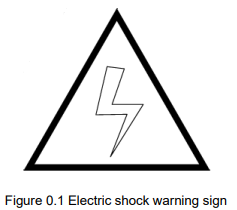
Attention should be paid to the danger of high voltage and electric shock at the place where this sign is affixed.
(2) High temperature
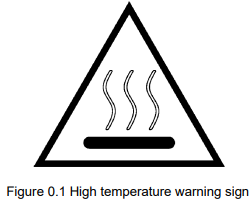
Be cautious about a section where this label is affixed, as the section generates heat. If you have to inevitably touch such a section when it is hot, use a protective provision such as heat-resistant gloves.
(3) No stepping
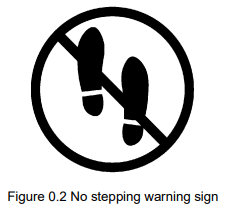
Do not step on or climb the robot as it may adversely affect the equipment, and cause the bodily injury to operators.
(4) Wounding by robot
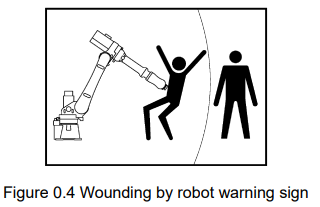
There is a danger of wounding by robot when working within the motion range of robot.
(5) Handling
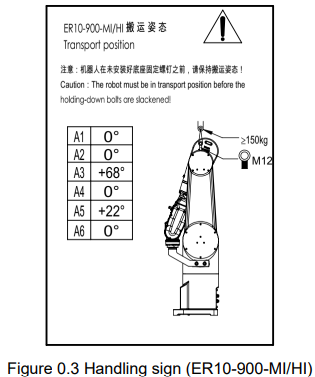
This symbol indicates the precautions for handling robots.
(6) No disassembly
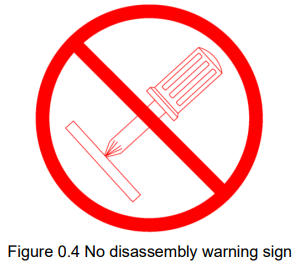
Users are prohibited from disassembling the part affixed with this sign. Disassembly shall be carried out by professionals using professional tools.
No comments to display
No comments to display