
10. Other function
10.1 Digital inputs and outputs
60FE (Physical outputs)
In some case, the switch (homing and limit switch) is committed by upper computer not servo drive.the signal is committed by object 60FE-01h(Physical outputs).
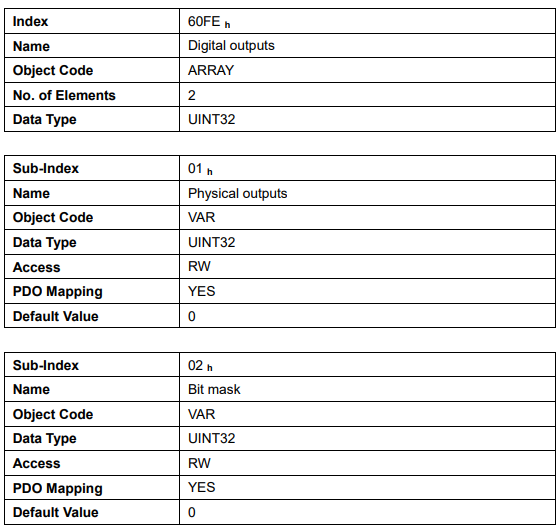

Bit16-bit23 of the object corresponding input signal terminal connector(CN1). The function of the terminals is formed by Pn509/510 or inversing Pn516/517. Enabled bus commit by Pn512/Pn513 for the bus commit bits. Refer to . Bit24-bit25 of the object corresponding input signal terminal connector(CN1). The function of the terminals is formed by Pn511 or inversing Pn528. Enabled bus commit by Pn512/Pn513 for the bus commit bits. Refer to .
60FD (Physical iutputs)
The host can read the object 60FDh(Digital Inputs) to monitor the switching inputs of the servo.
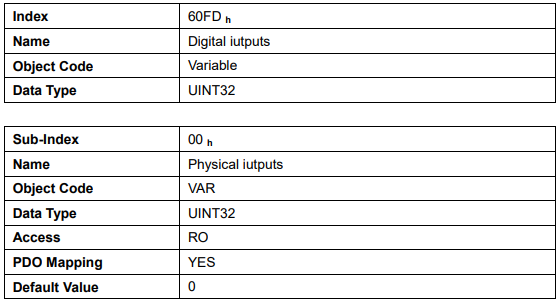

The terminals of Pn509、Pn510、Pn511 refer to <ProNet Plus Series AC Servo User’s Manual>.
10.2 Dummy object
To a better performance and save bandwidth of the bus ,the host can post data to the different slaves by the same PDO. COB-ID of slave’s RPDO should be set as the same value,and dummy object should be mapped to slave’s RPDO. Sometimes need to turn off some needless TPDO.
Example of mapping the first RPDO of two nodes:
Node1
0x1600-1 = 60C1 00 10H // Interpolated position
0x1600-2 = 0007 00 10H // Dummy object 32 bit
0x1600-0 = 2H
Node 2
0x1600-1 = 0007 00 10H // Dummy object 32 bit
0x1600-2 = 60C1 00 10H // Interpolated position
0x1600-0 = 2H
Host controller can use one PDO,and map the two slaves’interpolated position to the first and the second objects at the same time.
Example of programming COB-ID: revise COB-ID of Node 2 the first RPDO from 0x202 to 0x201
0x1400-1 = 80000201H //Restrict PDO,and write new COB-ID
0x1400-1 = 00000201H // Enabled PDO
Example of closing TPDO: restrict the second TPDO of Node 2 from transmitting (default COB-ID is 0x282) 0x1801-1 = 80000282H
No comments to display
No comments to display